That point in the night
when you want to say something
right but you’re too tired.
—
A haiku’s too hard
when your brain’s got no more cards
to play but madness.
—
A frigid, simple
rhyme will take no more time than
deadened syllables.
That point in the night
when you want to say something
right but you’re too tired.
—
A haiku’s too hard
when your brain’s got no more cards
to play but madness.
—
A frigid, simple
rhyme will take no more time than
deadened syllables.
I wish I had not learned the Golden Rule so well. Then I would not let fuckers like you be so blatantly rude to me while I turn the other cheek, look the other way so that you might laugh in the other side of my face too.
I would not let you get away so easily with your attack on my sense of contentment with my value as a person. I would make you atone for your attrition – or else do it for you. I would pull a gun on you, as you sit there in your drop-ass car with your backwards hat, jeering at me through your rear view mirror like the fucking scum you are. Who fucking raised you that way? Who fucking let you become what you are? People like you, people who go out of their goddamn way to make somebody else’s day worse, to flaunt their privilege just to get in other’s way, to fucking get off on causing another’s misfortune – people like you, they don’t deserve to pollute the population on this earth. I would shoot you, if I had not learned the Golden Rule so well. I would be someone who carried a gun in the first place.
Sure, I might not have been there for you to inconvenience in the first place. But at least I would not have been the only one to carry that risk.
If I had not learned the Golden Rule so well, I would not have walked through my front door minutes ago crying, because once again, I let another person, another man do what he wanted to me while I sat there, silent. I would not be sitting here on my bed typing this in my bra and underwear, because I must be naked to allow myself this much raw and quivering rage. This is my rant. This is my anger. This is me.
But you, man with the backwards hat in that car on the road, you will never know this.
Keep calm, carry on. Seek justice, but only for those others, and never for yourself. This is the way that peacetime works.
Let the man push you. Let him threaten you. Let him prevent you from leaving. Don’t kick his car door in. Don’t fling the car door out, sucker punch him to the gut. Don’t pick up your bike and walk in front of the goddamn prick. Don’t show him any resistance.
Keep calm. Stay quiet. It’ll pass. Then you can leave.
But there’s no justice in that.
I wish I had not learned the Golden Rule so goddamn well.

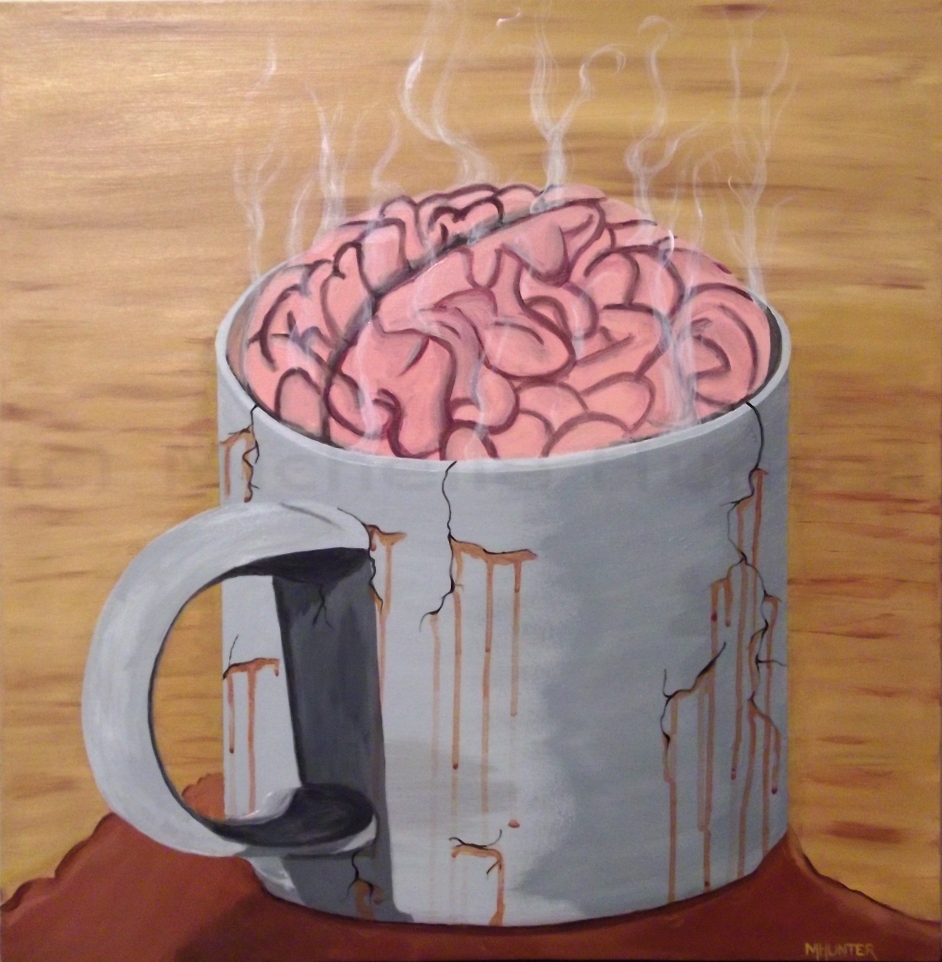
There is something comfortable to holding a hot mug of coffee in your hands, fingers cupped around it while a gentle heat exchange between capillary and vessel quietly bonds you together. It’s the modern Thinker’s pose, in a way. Elbows resting no matter where, cup steaming between dreaming fingers, eyes looking over the sconce off in the distance, as if it held future just before time dipped out of sight. The grey and wet city street, the dry and dusty desert playa – they’re both the same. I was away at Burning Man last week and sat on empty truck bed, the long wooden kind that semi’s use to tow things. It was a Friday, the day that my roommate and I always have our coffee date in the morning, even in the desert.
We rested our coffee away from the edge and then wriggled our way onto the bed as well, hoisting ourselves up using elbows and fists and wheels as necessary. We grabbed our respective cups and then, for near an hour, we talked. Just talked. But when you’re cupping a mug of coffee, what would other be just a seat becomes a perch. A spot like a semi truck bed becomes a space. Rambles become musing, garbled whispers revelations. There’s something that invites truth-telling, in those flickers of steam in front of your face. Coaxing tendrils that threaten litmus should you lie, as if their calm clear grey might fire up into red if you throw a falsehood at them.
At least, that’s how it was, retrospectively, in the Black Rock desert, that morning. Perhaps I anthropomorphize too much, though.
Or maybe I just really like coffee…

source
This is my home.
Well, that is, in an extended sort of way. I grew up in St. Louis, on the other side of town. Or rather the other “quarter” of town, because that is always how St. Louis has been divvied up, based on its socioeconomic populations. There’s West County, the safe, predominantly upper-middle and upper class white suburbia of St. Louis. Then South County, the older part of town populated by the lower-middle class echelon of African Americans and elderly white folks – unless you hit the “West End,” the posh upper class carved-out part of downtown. Then East St. Louis, the portion of my city responsible for putting us at #1 on the US’s Most Dangerous Cities list some years back. And finally, NoCo. North County. Ferguson.
Ferguson was essentially another SoCo. A mix of lower-middle class folks that in St. Louis constituted the “average African American,” “white trash,” and “old fogies.” My paternal grandmother lived there for most of her life. For me, it was a place to visit. Not a place to live. But still, it was a place that while I was in high school my mother would have only required me to call her when I got there and when I was leaving, not every five minutes, as would have been the case with downtown or East St. Louis.
Ferguson was not supposed to be that much of a time bomb.
I have never particularly loved my city. In fact, come the close of high school, I did every damn thing I could to get myself out of it. The Midwest, it’s such a closed-in place. The same sights, same ideas, same issues. All just sitting there. Caged in the bound middle of the country. Stewing. I ran away to the West Coast, where people colorful and vibrant in every sense of the words filled the streets.
The Midwest has always frightened me. It is a place of putting up white picket fences to hide the blood pooling in our yards from the wounds we all carry. It is a place where racial tension continues to draw and quarter our city, literally, and yet nobody will talk about it.
It’s a place where a wrong (i.e. “liberal”) word can get you hit by you father and a wrong movement can get you shot by a stranger.
It’s a place where everyone dresses according to the rules of their sector. Different branches of the same store will carry different types of clothing, depending on whether they’re catering to the prep kids of West County or the blinged-out teenagers of SoCo.
It’s a place where trusting the police force is a crapshoot. It’s all one big algorithm, hinging on variables like skin color and county location and whether or not you happened to be driving a particularly nice car. My grandfather was once head of security for much of downtown; it was always his mission to diffuse any issues with the least amount of conflict necessary. He wanted to calm people, not create statements. It was people he worked to keep safe, over buildings or signs or ideology.
Apparently not so, these days.
My city resounds with the cry of “I am big and you are little. I am right, and you are wrong.” It is a presumption that has always terrified me the most about that Arch-bound city. Walk under that Arch, and you must subscribe to a certain level of conformity. Break from that conformity, even just gathering to say that you don’t agree with the way something is going down, and – well, I guess we’re seeing now how that plays out.
I am right, and you are wrong.
Stay on your side of this line, and I’ll not say you’ve threatened mine.
My city is divided into four quarters. Apparently now we’re killing to keep people in them.
I’m sorry, Ferguson. I didn’t ever think we’d treat you this badly. The whole point of calling something a “quarter” is to indicate it’s needed to make up part of a whole.
Despite all its posturing, my city has not been whole for quite a while now.
I have a preference for emptiness.
Or rather, I have a preference for possibility. The blank space full of a thousand million hundred outcomes, undecided and bubbling with whispers of choices competing for resolution. A blank space is so many finished products, each one undone in perfect construction. No mistakes yet.
Emptiness has a cleanliness to it, a space to breathe with only the dust to tickle your lungs and make you cough, no memory yet to cause that other choking. “This space is yours,” an undressed room will croon. “Put the trappings of yourself here.” No procrastination or dirty laundry miring on the floor, no dividends or odds and ends of life you always meant to get around to. Only life with perfect space for itself there in that blank room, waiting.
Or the winking encouragement of unwritten lines on a notebook page. “What are your words?” the leaves rustle softly to you in invitation. “What murmurs do you hold for us?” Agency and empowerment, all in ink scratched onto blank piece of paper. Your creation. Your word. Your mind. Your world, there for the making.
Blank space in life is a canvas, after all.
I always fear to produce inadequate instruments. What if I pull the strings, tie up the package wrong?
I fear leaving the wrong kinds of cracks and creases.
There is something so sacred, in that first perfect line through emptiness.
It’s too late a morning for what I’d planned,
hours of dream-thrashing that left me sweaty
what I wake up to, instead of the cool and metal sheen of dawn.
The shrunk-down woken-up figures of odd dreams and bad memories
wrestle round my neuron junctions, pulling at threads
and threatening connections that would sooner be left alone.
I re-heat the coffee and guzzle it down like magic,
hoping to thrust my mind through enough caffeination
to rid me of this rough-delivered headache
and release me, forgetting and free.

Life is a hard thing when you go numb. When soul dies, hopes dissipate into nothing leaving not even a shadow of an imprint.
Silence is a terrible thing. I hate it. I fear it. I fear it, because I fear me. Silence means I’m left alone with myself. And that’s terrifying.
Silence means I only have the chatter of my brain to keep me company. And when that chatter comes in the form of verbal knives and memory punctures, those internal conversations can hurt a lot.
It wasn’t always this way.
I used to be able to sit alone with myself and dream. I’d spend hours thinking about problems I wanted to solve, things like biology research and magnetism projects. I’d turn the information I’d learned earlier over and over in my mind, looking for new angles or remaining questions to tackle a need with. I’d process things for hours, while I was swimming, or walking through a grocery store, or driving, or scribbling in a notebook. It was fun. I was content.
Or I’d think about stories. I’ve written entire novels in my head, always meaning to transfer them to paper later. I’d flesh out scenes and plot, playing them out in my head like a movie while I was showering, or sitting in an airplane, or bored in class. I have had worlds spun into being inside my head. I loved the feeling. That’s who I was.
It’s part of the reason I love art museums. Wandering through galleries, staring at canvas after canvas, the paint on the picture starts speaking stories in my brain. I love art that I look at and immediately think, “there’s a story in that.”
I love doing art too, in and of itself. It’s almost like I’m creating some kind of secret. “Here, let me draw you this picture” – it’s got a fairy tale behind it. Or at least, it does in my head. Who knows the stories it may speak in yours.
The better I’m doing internally, the better I do at art. If I fall into eating disorder patterns, I stop being able to create proper scale in my drawings, especially when it comes to people. The more stable I am in terms of ED, the more accurately I’m able to draw humans. The more there I feel inside, overall, even if it’s a hurting sort of “there,” the more I’m able to do some sort of creation. Even if it’s just sketching out eyes. Simple, closed eyes.
That’s what I did, when depression and suicidality first hit me in the clinical sense my senior year of high school. My school planner is full of eyes, blue pen sketches of what’s really no more than a glorified eyelid, covering almost every page. Eyes, everywhere. Closed.
There’s probably some symbolism in that.
But now… now I can’t even draw eyes. Even short poems, little bursts of anger or hurting or hopelessness, the ones that I used to be able to throw onto a page in a blink, they’ve become harder to write. There’s no voice left in me.
There’s only the silence, with its terrible chattering.
And I hate it.
There’s another spot, another corner of content curation that I decided to take a stab at, here on the internet. I hear there’s a thing called Tumblr. I still don’t entirely understand it. How it works. What the fuck it’s even there for. But I’ve got one – decided to call it “Mad Woman Blinking.” (Oh hey, more eye symbolism!) And I decided that it’s there for my art. More so the visual kind, though I’ve got a fair amount of word spew on there too. You can check it out or not, that’s really not the point. I bring it up because yesterday, I also wrote a post called “Silence” there. It’s a shorter version of what I’ve written here. But it’s differently phrased, and I feel like the language has more art to the wording. It’s the more compact, drip-coffee version of what I could squeeze out of my soul. Looking back, I’m glad that there was some poetry to it.
“Silence usually means I’m not okay. In life, when I fail to stop by a friend’s dorm room, or stop contacting my people in all their little chat boxes. In art, when I just stop doing it.
My art habit fluctuates wildly. I’ll go a couple of months where I do art every day, or at least every week. Then I’ll have a year of not even scribbling on a napkin.
I’m not okay when I’m not doing art.
Because if I’m doing art, it means I’m stable. I’ve got the time to sit down with pencils or acrylics or whatever. I’ve got soul enough inside me to pin dreams down on papers in their many colors of imagination. I’ve got sense of self enough to still make my fingers etch out a story, whatever their medium.
When I stop drawing, it’s because I’ve gone silent inside. And that means I’m not okay.”
I’d really like to be okay.
Is poetry important?
Is poetry important?
Tell me – do you breathe air? Or if not air, do you breathe at all?
Do you carry within you the in and out, in and out rhyme
of a life still whispering small sounds keeping time?
Do you hold within you the cadence of sighs,
turning your very nostrils into music-making machines
and your lungs a chorus of singers
meting out your metered ties to existence?
Then I would say that poetry is important.
Is poetry important?
Tell me – do you push and pump a beat.beat.beat.
in an iambic muscle that measures your life
in a glorious kind of pentameter?
Have you ever fallen into step
or tapped your fingers to a pulsing summat
caught inside your head?
Do you walk a certain way over sidewalk cracks?
Then poetry is important.
Is poetry important?
Tell me – do you ever look in a mirror?
Or wish it reflected a little something more?
Do you value possibility?
Do you value truth?
Do you ever yearn for a beautiful lie?
Or wish for something to make you cry?
Do you find assurance in a newborn’s breath?
Then poetry has not yet found its death.
Is poetry important?
I’d hazard yes.
Dark One
I worry I am too much chaos. You stand there, in your sweet and indeterminable beauty, and you think I am frail because you see me cower. But I am only crouching, trying to hide from you my soul as it glowers.
I am a stormy soul, oh light one. I worry I might obliterate you if we were to crash together.
Insanity so easily swallows up naked possibility.
I’m worried we would go insane, if I tried to swallow you.
But you are so tempting, you over there with your soft breezes and gentle kisses blown at me with a wave. Your fingers chide my suspicion so cheerfully.
I am fearful to wave back; I do not trust my darkened sensibilities. They can so quickly snuff a greeting so bright as yours.
Ah, but you might taste so sweet, as I devoured you…
And the end of what you promised – well, death need not always be a wretched case.
But would it be so easy for me to say that then as I watched you limp away, wounded?
Penning
I don’t know how they do it,
those strangers who find my soul.
They do not know me.
They do not even write to me,
but there, somewhere in the echoes
of the story they were telling
or the thoughts they were thinking
or the love they were feeling slip from their bodies,
I find myself.
In the dust you only see in the streak of sun
from the skylight,
little ephemera dancing there in the silence
near your upper rafters,
little cosmic ballerinas you would not have noticed
if you hadn’t been bored and staring at nothing.
They find the rafters in me,
and strike an organ that resonates and shakes me a bit,
all that memory.
The words were not written for me.
But what’s written is me,
in a way.
I wonder how they do it,
the strangers that trace me with their pen
and yet do not even know that they’ve found my shadow.
I wish they perhaps knew what they’ve caught on their line,
though I am grateful –
I feel a might less invisible, otherwise.


 Quill Aquiver
